

If you’re feeling pain, numbness, tingling, or weakness traveling from your neck down into your shoulder, arm, or hand, you might be dealing with cervical radiculopathy—often referred to as a pinched nerve in the neck.
This condition can be confusing and frustrating. After all, why would a neck problem cause pain in your arm? Let’s break it down in simple terms and explain how physical therapy can help.
What Is Cervical Radiculopathy?
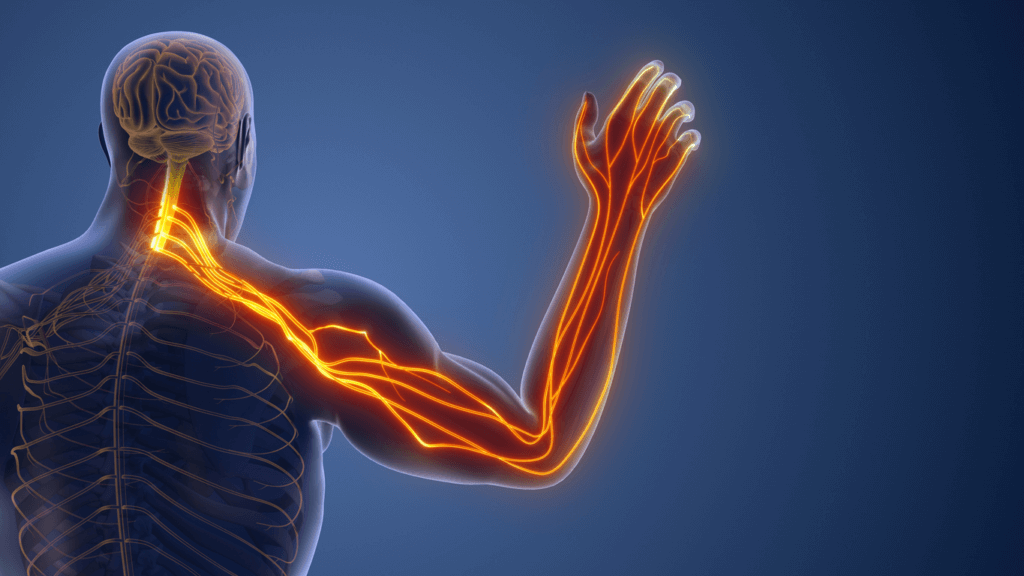
Cervical radiculopathy occurs when a nerve in the cervical spine (neck) becomes irritated or compressed as it exits the spinal column. These nerves travel from your neck into your shoulders, arms, and hands—so when one is irritated, symptoms can show up far away from the neck itself.
Think of it like a kink in a garden hose: the problem starts at the source, but the effects show up downstream.
Why Does Cervical Radiculopathy Cause Arm Pain?
Each nerve in your neck is responsible for sensation and strength in specific areas of your arm and hand. When a nerve is compressed, it can cause:
- Sharp or burning pain in the shoulder, arm, or hand
- Numbness or tingling in the fingers
- Muscle weakness in the arm or grip
- Pain that worsens with certain neck movements
That’s why arm pain doesn’t always mean an arm injury—the neck may be the real source.
Common Causes of Cervical Radiculopathy
Cervical radiculopathy can develop for several reasons, including:
- Disc herniation (a bulging or ruptured disc pressing on a nerve)
- Degenerative changes like arthritis or bone spurs
- Repetitive strain from work or sports
- Trauma, such as whiplash or a fall
- Weakness, especially of cervical, postural, and scapular muscles
In many cases, symptoms develop gradually rather than suddenly.
How Is Cervical Radiculopathy Diagnosed?
Diagnosis usually starts with a thorough clinical exam, not just imaging. A physical therapist or medical provider will assess:
- Neck mobility and posture
- Strength and sensation in the arms
- Reflexes
- Symptom patterns with movement
Imaging such as an MRI may be used in some cases, but symptoms and movement testing often matter more than what a scan shows.
How Can Physical Therapy Help Cervical Radiculopathy?
Physical therapy is one of the most effective first-line treatments for cervical radiculopathy—and often helps people avoid injections or surgery.
A physical therapy program may include:
- Targeted exercises to reduce nerve irritation
- Postural strengthening to unload the neck
- Manual therapy to improve joint and soft tissue mobility
- Nerve gliding techniques to restore normal nerve movement
- Education on activity modification, ergonomics, and sleep positioning
Rather than just treating pain, physical therapy focuses on addressing the underlying cause and preventing symptoms from returning.
When Should You See a Physical Therapist?
You should consider seeing a physical therapist if you have:
- Neck pain with arm symptoms lasting more than a few days
- Tingling, numbness, or weakness in the arm or hand
- Pain that worsens with neck movement
- Difficulty sleeping or working due to symptoms
Early intervention can make a big difference.
Take the Next Step Toward Relief
Physical therapy can help relieve symptoms, restore movement, and get you back to doing what you love—without surgery or medication dependence.
If neck pain is causing arm pain, numbness, or weakness, physical therapy can help properly evaluate and improve your symptoms. Call Respire Physical Therapy at the Falls Church Location (703-671-1871) or the Annandale Location (571-369-6728) to schedule an appointment with one of our skilled Physical Therapists today! Click here to request an appointment online and we will contact you as soon as possible.

Tags: annandaleva, physical therapist, painfreeliving, neck pain, washingtondc, health blog, movementismedicine, cervical radiculopathy, cervical neck pain, choosept, pt education, arlingtonva, evidence based practice, alexandriava, Physical Therapy, fallschurchva, Respire Physical Therapy, ptworks, Numbness and Tingling